How LiftGateMe Turned 150 Legacy Parts Manuals Into a Connected Buying Experience
LumaRef's founding use case shows how manufacturers and aftermarket businesses can turn legacy technical content into a practical path from question to part.
LumaRef Team
Founding Story · · 10 min read
LumaRef's founding use case shows how manufacturers and aftermarket businesses can turn legacy technical content into a practical path from question to part.
At a glance
- Company: LiftGateMe, an aftermarket replacement-parts business serving the commercial liftgate and heavy-equipment market.
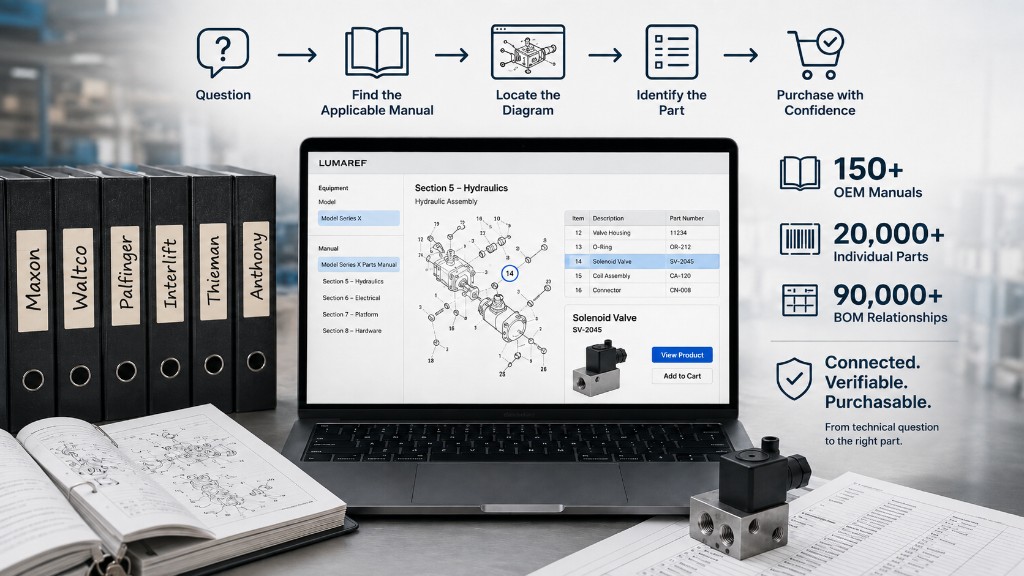
- The challenge: Critical product knowledge was spread across approximately 150 OEM manuals containing thousands of diagrams, more than 20,000 individual parts, and over 90,000 bill-of-material rows.
- The approach: LumaRef transformed that legacy content into structured, model-aware knowledge connecting equipment, manuals, diagrams, parts, and current products.
- The result: Customers and staff can move from a technical question to the applicable diagram, verify the correct part against the original source, and continue directly to the purchasable product.
The information existed. Reaching it was the problem.
LiftGateMe helps customers identify and purchase replacement parts for commercial liftgates from manufacturers such as Maxon, Waltco, Palfinger, Thieman, Anthony, and others.
Finding those parts is rarely as simple as searching for a familiar product name.
A customer may know the manufacturer and model of the equipment but not the part number. They may have an older unit, an incomplete serial number, or a component that looks similar to several other parts. In many cases, the correct answer can only be found by locating the applicable manual, navigating to the right section, reviewing an exploded diagram, and matching an item number to a bill of materials.
The answer usually exists. It is simply buried inside a PDF.
Each manufacturer organizes its technical documentation differently. Part numbers may appear in diagram callouts, tables, footnotes, supersession notes, or model-specific sections. Manuals may cover several product generations, while individual parts may only apply to a narrow date range or configuration.
PDFs are useful for distributing documentation. They were not designed to power a modern parts-buying experience. That distinction created a growing gap between the information LiftGateMe possessed and the knowledge its customers and staff could easily use.
The cost of disconnected technical content
For customers, a basic question such as Which switch fits my model?
could turn
into a lengthy process. They might search the website, open several manuals,
compare diagrams, call for assistance, wait for a response, or abandon the
purchase because they were not confident enough to order.
A major challenge behind this experience is scale. With tens of thousands of unique parts, many product pages simply do not have images. A part number alone rarely provides enough context to confidently identify the correct component, especially when multiple parts appear similar or have evolved over time.
Even when a customer finds a part number, there is often no clear connection back to the manuals or diagrams where that part appears. Without that link, both customers and staff are left without the visual and technical context needed to confirm where the part is located on the equipment and whether it is truly the correct match. While a diagram is not always a perfect substitute for a real-world image, it often provides nearly the same level of clarity when properly connected.
For LiftGateMe's staff, the same problem appears in a different form. Routine questions often depend on knowing which manual might contain the answer, how a particular manufacturer organizes its documentation, or which part numbers have changed over time. In many cases, identifying the correct manual itself can require contacting the manufacturer, especially with older or less clearly documented equipment.
LumaRef does not eliminate every one of these challenges, but it significantly reduces the distance between question and answer. The result is not a perfect system, but a far more connected one — where existing technical content becomes usable, scalable, and far closer to the level of clarity needed to make confident decisions.
LumaRef began with this problem
LumaRef was born from LiftGateMe's need to make its existing technical content more useful.
The goal was not to replace every manual, rebuild the ecommerce store, or force customers into a separate documentation system. The goal was to create a connected knowledge layer using the content and systems LiftGateMe already had.
LumaRef processed LiftGateMe's OEM manuals, illustrated parts catalogs, exploded diagrams, and bill-of-material tables, and organized the relationships within them:
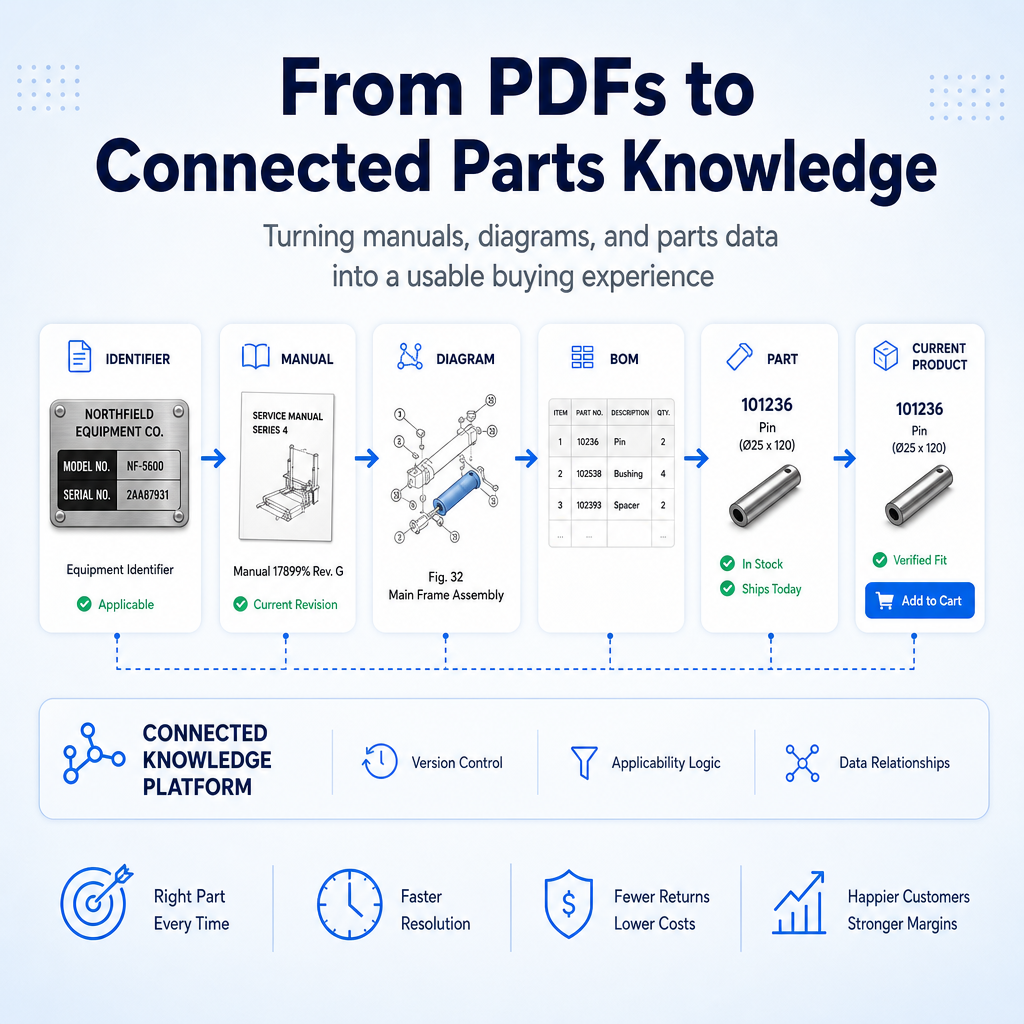
Manufacturer → Model → Manual → Section → Diagram → Part → Product
Those relationships are what turn a collection of documents into usable product knowledge. A part number is more useful when it remains connected to the diagram where it appears. A diagram is more useful when it is connected to the equipment models it covers. A technical answer is more useful when it leads directly to the current product a customer can purchase.
Modernizing the content without starting over
LiftGateMe did not need to rewrite 150 manuals or manually re-enter tens of thousands of part references. LumaRef started with the documentation the manufacturers had already produced.
The manuals remained the authoritative source. LumaRef added structure around them — identifying the manuals, models, diagrams, item numbers, part numbers, and product relationships contained within the files.
This allowed LiftGateMe to modernize years of technical content without replacing the systems already supporting its business. The company already had an ecommerce platform, product pages, customer workflows, and internal processes. A useful solution needed to strengthen that existing environment rather than create another disconnected destination.
Bringing technical discovery into the shopping experience
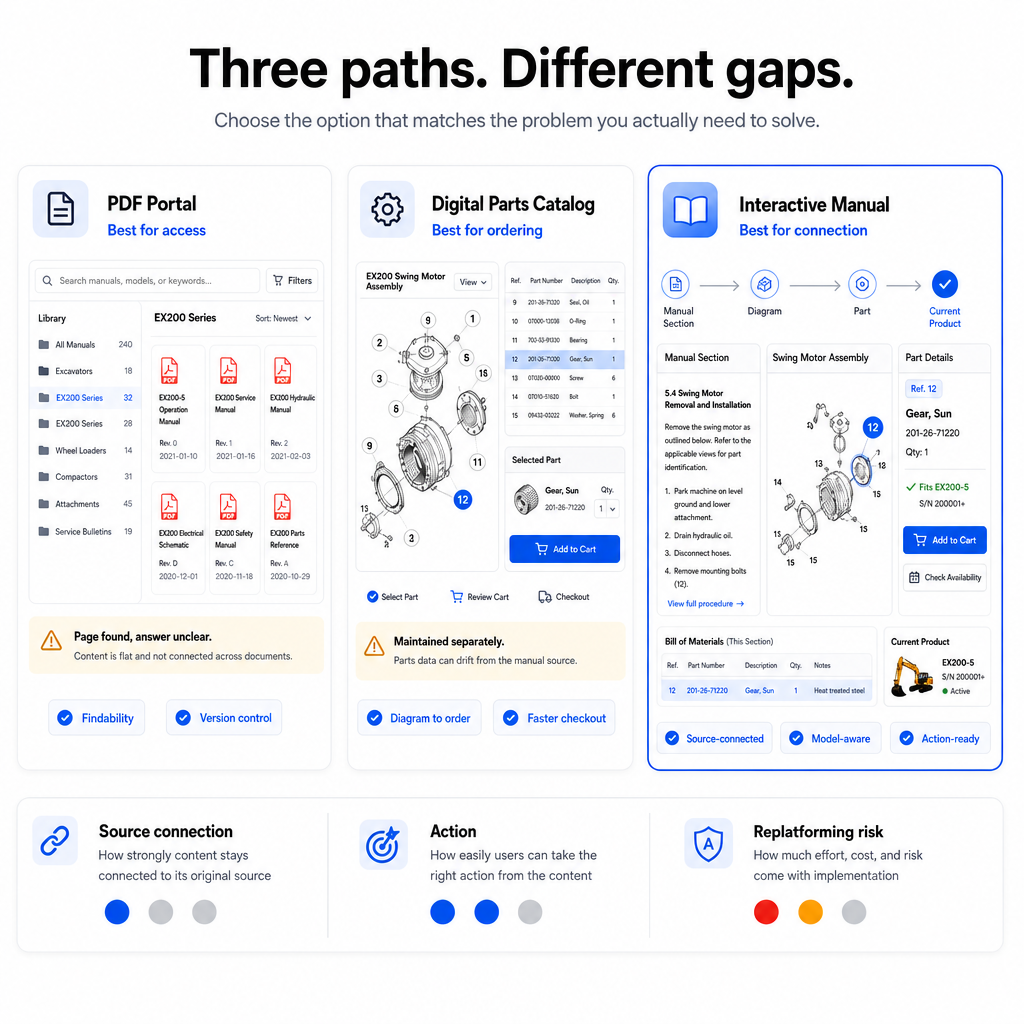
Traditionally, documentation and ecommerce live in separate worlds. A customer leaves the store to search a PDF, finds a possible part number, and then returns to the store to begin another search. Every transition introduces uncertainty and another opportunity for the customer to stop.
LumaRef shortened that path. Customers can begin with the equipment or model they are working on, navigate the relevant diagrams, review the matching bill of materials, and continue to the corresponding product without restarting the journey.
Instead of asking customers to trust a search result alone, the experience gives them the evidence they need to verify the decision:
- the applicable model
- the original manual
- the relevant diagram
- the highlighted item
- the matching bill-of-material row
- the current product available for purchase
This creates a continuous path from discovery to confidence to action.
From question to diagram to purchasable part
Consider a customer trying to identify a switch for a specific equipment model.
In a traditional workflow, the customer may need to determine which manual applies, scan its table of contents, locate the correct assembly, inspect the diagram, find the item number, match it to a table, copy the part number, and search the store.
With the connected experience, that journey becomes much shorter:
- The customer begins with the model or technical question.
- The applicable source and diagram are surfaced.
- The relevant diagram item and bill-of-material row are identified.
- The customer verifies the part against the OEM documentation.
- The customer continues to the corresponding product.
The answer does not end in a paragraph of text or another downloadable file. It leads to the next useful action. That is the difference between document search and a connected parts experience.
Giving customers greater confidence
Replacement-parts purchases carry a natural level of uncertainty. Customers are often working with older equipment, faded labels, incomplete records, and components that may have changed across production years. Ordering the wrong part can mean downtime, additional shipping costs, returns, and another round of troubleshooting.
A conventional product page may display a description and photograph, but it does not always show why the part applies to a particular unit. LumaRef adds that missing context. By connecting products to their original diagrams and documentation, customers can inspect the source before purchasing — seeing where the part appears, which item number identifies it, and which models or assemblies the documentation covers.
This does not remove every complex fitment question. Some situations will always require expert assistance. But it does allow many customers to answer routine questions independently, and gives them a stronger foundation when they do contact the LiftGateMe team.
Turning tribal knowledge into shared knowledge
The same foundation that supports customer self-service also improves the internal staff experience.
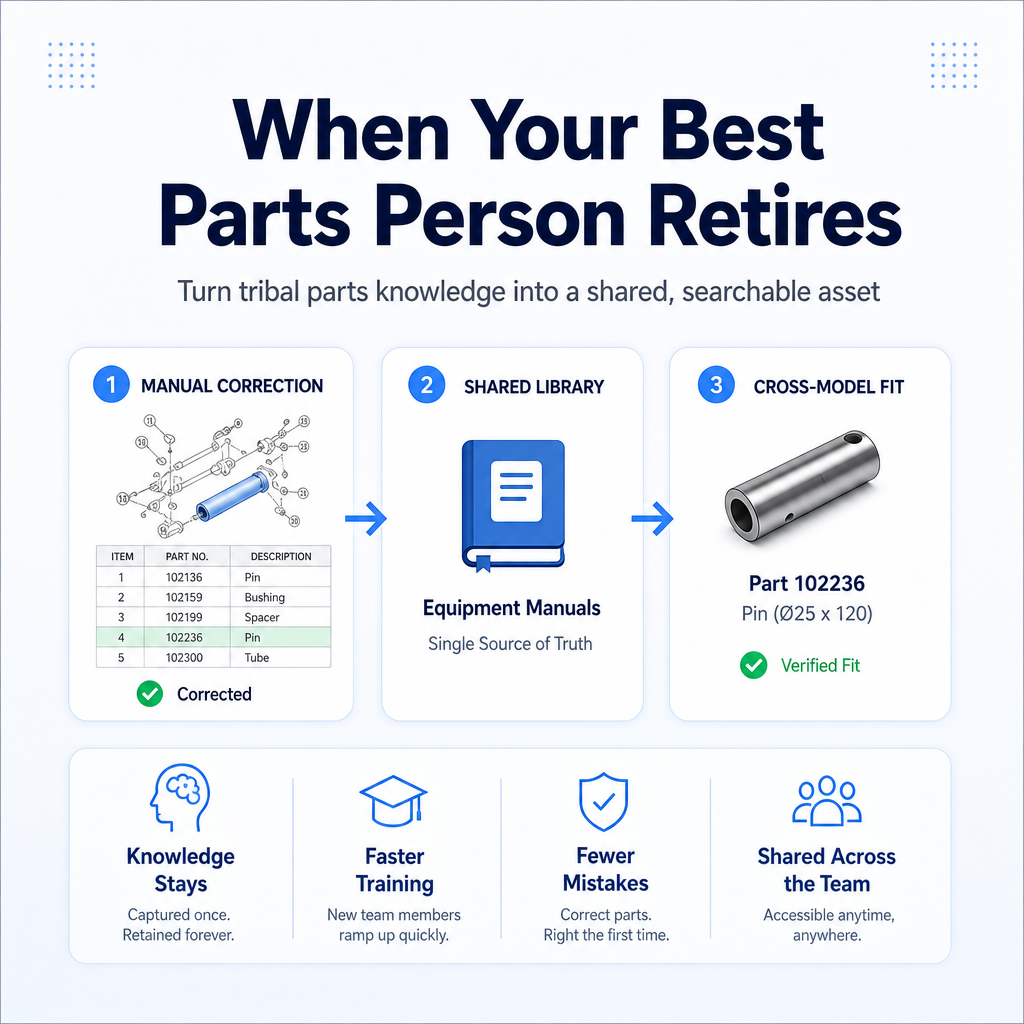
A newer employee no longer needs years of familiarity with every manufacturer's documentation before helping with common identification questions. Instead, they can quickly locate the relevant source, review the diagram, confirm the part while staying grounded in the original technical content, and share that exact context directly with the customer so they can verify it themselves.
This makes the team less dependent on a single experienced person remembering where an answer is hidden. Technical knowledge becomes a shared business asset rather than information stored in individual memory.
For experienced employees, the benefit is equally important. They can spend less time repeating routine document searches and more time helping customers with unusual configurations, incomplete information, or genuinely difficult problems. LumaRef does not replace the expertise of the parts team — it makes that expertise easier to apply and easier to extend across the organization.
One knowledge foundation, many useful experiences
LiftGateMe's connected parts experience is not limited to a single search interface. The same structured foundation can support several customer-facing and internal experiences:
- interactive versions of legacy parts manuals
- searchable exploded diagrams
- highlighted diagram images
- connected bill-of-material tables
- product links from diagram items
- source-backed answers for staff in our AI (beta) product
- technical content embedded within your existing ecommerce website
- shareable visual references for customer support
- model-specific parts discovery
The underlying work does not need to be repeated for every channel. Once the relationships between the equipment, model, documentation, diagram, part, and product are established, that knowledge can be delivered wherever customers or employees need it.
This is what allows technical content to become more than a library of files. It becomes infrastructure for customer service, parts discovery, ecommerce, and aftermarket support.
Why this matters beyond LiftGateMe
The documentation challenge LiftGateMe faced is common across the equipment aftermarket. Manufacturers and distributors often have decades of valuable technical content, but much of it remains locked inside PDFs, disconnected portals, shared drives, and the memories of experienced employees.
The business already owns the knowledge. What is missing is the structure that makes the knowledge usable.
LumaRef helps close that gap without requiring companies to discard the documentation or platforms they already rely on. It connects legacy technical content to the models, diagrams, parts, products, and actions that matter in the real world.
For LiftGateMe, that means moving closer to a simple but ambitious goal: make every part discoverable, keep every answer connected to its source, and never make someone retype a part number just to continue the buying journey.
Build a connected experience from the content you already have
Your manuals, parts catalogs, diagrams, and product data already contain years of technical knowledge. LumaRef turns that content into a structured, model-aware foundation that can support customer self-service, staff assistance, parts discovery, ecommerce, and other technical experiences.
See how LumaRef can connect your technical content to the people and systems that need it.