When Your Best Parts Person Retires
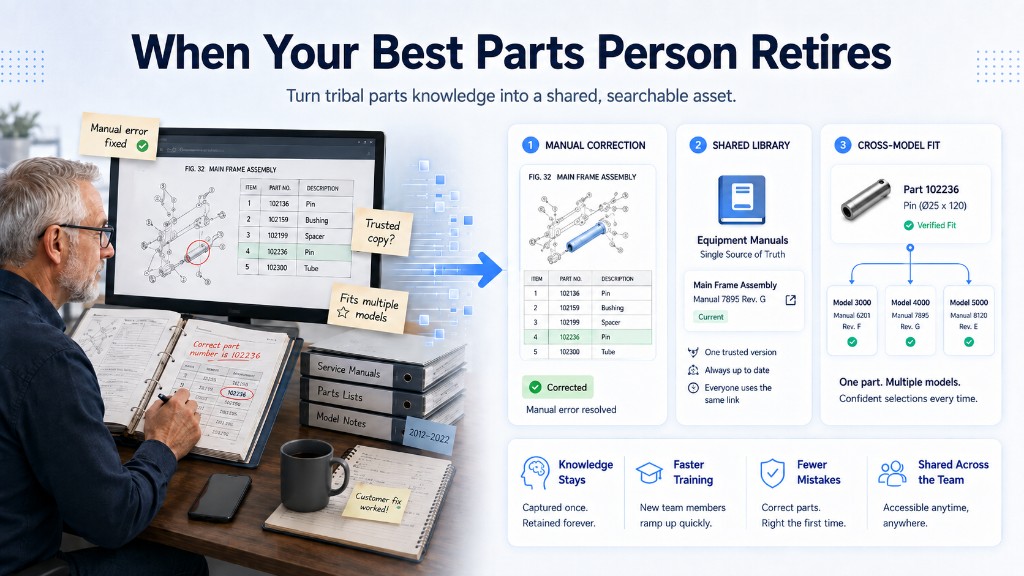
A veteran parts employee doesn't just remember where to look. They know which manuals have uncorrected errors, which local file is the trustworthy one, and which parts quietly fit more than one model. None of those three actually requires memory.
LumaRef Team
Content Team · · 6 min read
A parts manager who's been there nineteen years doesn't reach for the PDF
manual when a customer says a part doesn't look right.
She already knows
the manual is wrong. A supplier swapped the part numbers for the left and right
hydraulic cylinders in an illustrated parts catalog years ago, and the error
was still sitting in the manufacturer's next three revisions after that. She
caught it the first time a customer's cylinder didn't fit, and she's
corrected it from memory every time the question has come up since. Nobody
ever wrote the correction down anywhere a newer employee could find it.
That's the part of this risk that's easy to underestimate. It doesn't show
up as a missing document. It shows up as a person — and what she actually
knows is more specific, and more fixable, than she's been here a long
time.
A veteran parts employee's knowledge usually isn't really about knowing where to look. It's catching errors in the PDF manual itself that nobody's corrected, working from files nobody else can find, and knowing which parts quietly fit more than one model — and all three of those can live in documentation and data instead of memory.
A risk that's arriving on a schedule
This isn't a hypothetical staffing concern. U.S. Census Bureau research published in December 2025 found that the share of manufacturing employment at firms where at least a quarter of the workforce is 55 or older rose from 14% in 2000 to more than 40% in 2022 — a structural shift in the age profile of manufacturing and adjacent production sectors that happened over less than two decades. A meaningful share of the people who currently hold the most institutional knowledge about a company's older products are within a decade of retirement, whether or not a specific succession plan exists yet.
Three kinds of knowledge no document holds
Tribal knowledge
usually gets treated as one problem. In practice it's
closer to three, and they call for different fixes:
- knowing a manual has misinformation and knowing not to fully trust it
- knowing which saved copy of a file to trust
- knowing that a part fits models and can be interchanged
When the manual has been wrong for years
Manuals ship with real errors more often than most people assume, and unless someone catches one, it just sits there uncorrected. A mislabeled part number in an illustrated parts catalog gets carried forward, revision after revision, until someone downstream notices the part doesn't match the machine.
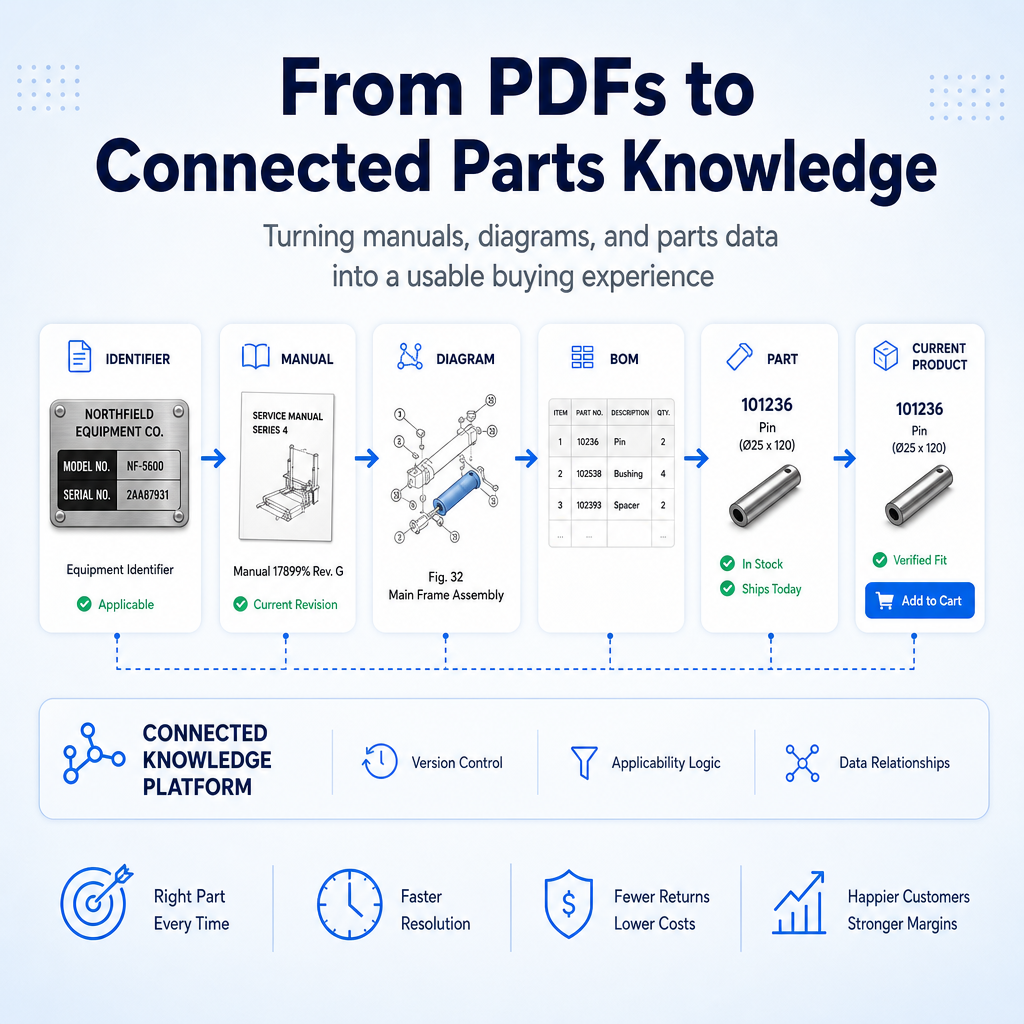
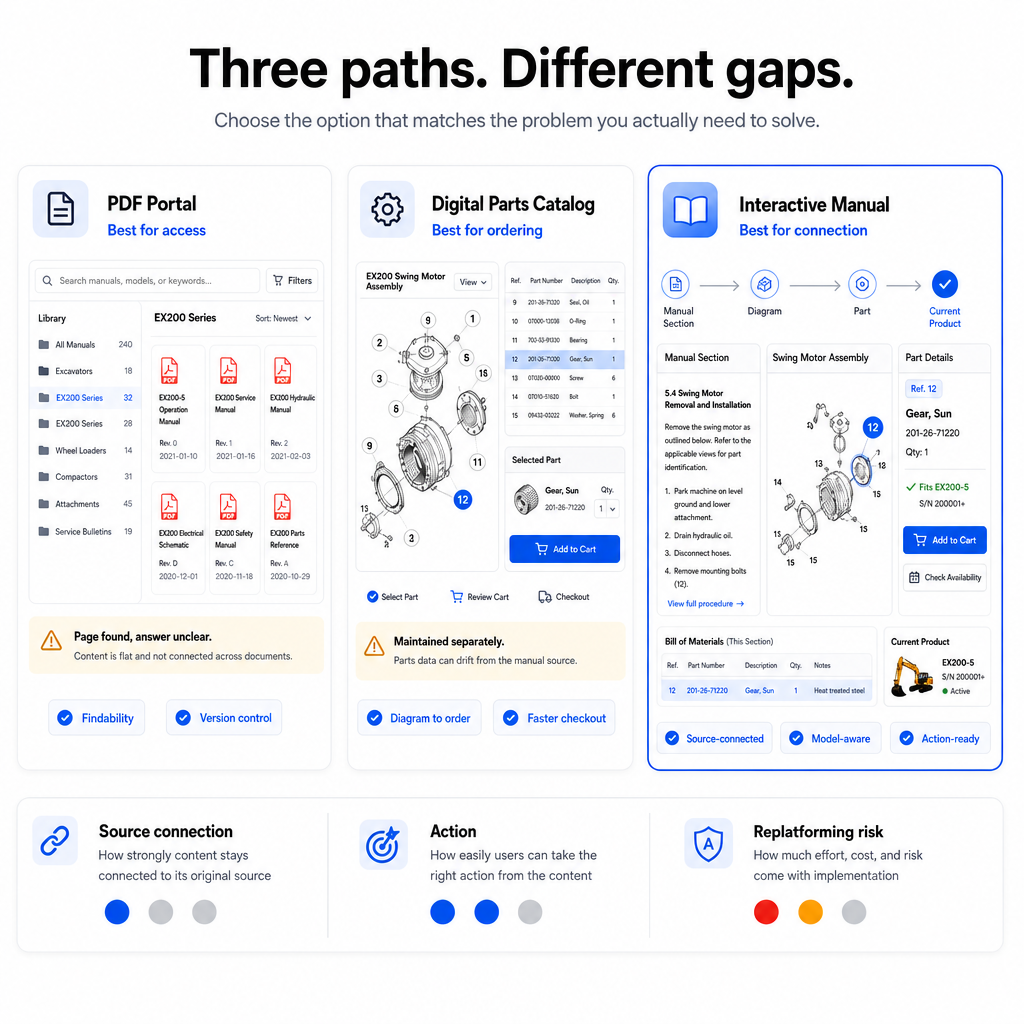
Waiting for the manufacturer to correct it means waiting for their next print cycle, which might be years away, if it happens at all. Once a manual has been converted into an interactive one, that wait isn't necessary: the specific part number or description that's wrong can be corrected directly, and the fix shows up on the hosted manual page right away — no new PDF, no waiting on a revision that may never come. If the same manufacturer error was carried into several revisions of the PDF manual, each one still needs its own correction, but none of them require anyone's permission or anyone's memory to fix twice.
When the manual
means whichever laptop it's on
The same veteran employee often has her own saved copy of manuals that have been created over the years - she knows which have errors, which relate to special builds, and which have the correct fixes which others may lack. A newer employee pulling from the shared drive has no way to know that, so they get the uncorrected version and repeat the exact mistake she already solved.
That's a predictable outcome of manuals living as separate files instead of
one shared, current source. LumaRef closes that gap by hosting every
converted manual in a single library that everyone reaches by the same
link, so there's no competing good copy
sitting on someone's desktop —
the corrected version simply is the version everyone opens, whether that's
an employee looking something up internally or a customer following a link
shared with them directly.
When one part quietly fits more than one model
Some of the most valuable things a veteran employee knows aren't errors at all — they're patterns nobody documented. A bracket for a 2015 model might fit the 2012 through 2014 models too or even another model that is completely different, something she knows only because enough customers have called about it over the years and she's spoken to engineering. That kind of cross-model fit matters to a salesperson quoting a customer who owns several units, and to a customer who wants to know if one part covers more than one machine they own — and today, that saved knowledge usually depends on whether that specific employee is the one who picks up the phone to answer the support call.
When a living document solution is implemented, that part is matched to the same product across every manual it appears in, that pattern stops living in one person's memory. A parts manager or salesperson can look up the part and see every manual, section, and model it's tied to, instead of only the one manual they happened to open first. Where a business also publishes diagram images for those matches, a customer browsing the product page can see the same thing directly — the part shown against more than one manual, each one labeled by the model it came from.
The bottom line
The real risk isn’t that someone retires and takes years of experience with them. It’s that important details — which manuals are wrong, which files apply to special builds, and which parts fit more than one model — only exist in that person’s head. Once that knowledge is built into the manuals and parts data, the rest of the team can keep using it long after that person is gone. It’s the same shift behind how LiftGateMe turned legacy parts manuals into a connected buying experience: tribal knowledge becoming a shared, searchable asset instead of staying in one person's memory.
See how this works on real OEM manuals
LumaRef lets your team correct errors in a converted manual immediately, hosts every manual in one shared library instead of scattered personal copies, and shows everywhere a part has been matched across your manuals. Talk to us about your existing manuals and parts catalogs.